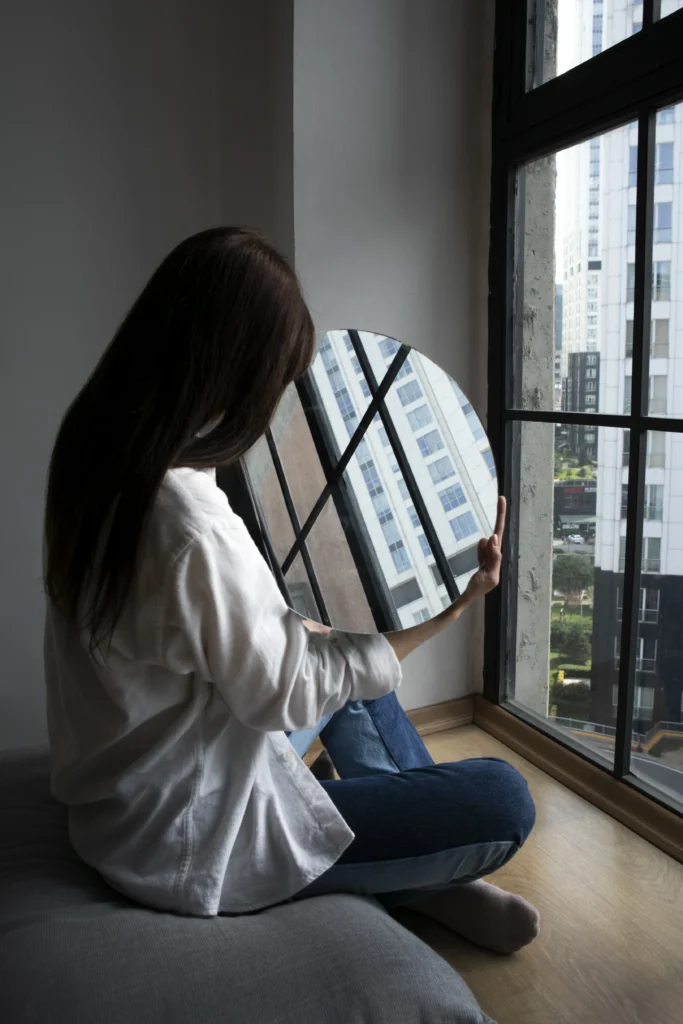
Wanting to be seen and terrified of it at the same time
You might secretly want to be more visible: to speak with confidence, share your work, be recognised for what you do. At the same time, the idea of being truly seen can make your stomach drop. You delay posting, avoid cameras, downplay your achievements, or stay in the background even when you are clearly capable. (resilientrootspsychotherapy+1)
From the outside, it looks like “shyness” or “being modest”. Inside, it feels closer to threat: “If they really see me, something bad will happen.” This is not irrational drama; it is often a learned survival response.
When visibility once came with a cost
Fear of being seen rarely appears out of nowhere. It is usually rooted in past experiences where attention, authenticity or taking up space led to some kind of pain:
-
Being criticised, mocked or shamed when you expressed yourself.
-
Being punished or rejected for “showing off”, having needs, or making mistakes.
-
Being praised only when you performed perfectly or were useful, not simply for who you were.
-
Growing up around bullying, jealousy, envy or harsh comparison. (oc87recoverydiaries+2)
From these experiences, the nervous system can learn core equations such as:
-
“Being visible = being vulnerable to attack or humiliation.”
-
“If I stand out, I will be cut down.”
-
“If they see the real me, they will leave or hurt me.” (useyourdamnskills+2)
Even years later, your body may react to visibility—giving a presentation, posting online, voicing a boundary—as if you were stepping back into those old situations.
Perfectionism and the invisible bar you have to clear
For many high‑achieving adults, visibility is tied to perfectionism. It is not enough to “just show up”; you feel you must show up flawlessly:
-
Every word needs to be precise.
-
Every project must be polished.
-
Every part of you that feels messy, emotional or insecure must be hidden. (m1psychology+2)
Perfectionism offers a temporary illusion of safety: “If I’m perfect, they can’t criticise me; if I hide my flaws, they can’t reject the real me.” The problem is that the bar is unreachable and keeps moving. Any small imperfection can feel like proof that you’re an impostor, which fuels even more fear of being seen. (thefarley+2)
This often leads to a painful loop:
-
You long for more visibility or recognition.
-
You set impossibly high standards for how you must appear.
-
You procrastinate, self‑sabotage or avoid opportunities.
-
You then feel ashamed for “staying small”, which confirms your harsh self‑judgment. (overcomeanxietytrauma+1)
Why your nervous system treats visibility like a threat
From a nervous‑system perspective, fear of being seen is usually a fear of relational danger: criticism, rejection, shame, loss of status, or loss of safety in the group. (sociallyfearless+2)
When your system has associated visibility with danger, signals like:
-
eyes on you
-
silence after you speak
-
posting something personal
-
taking a leadership role
can trigger fight, flight, freeze or fawn responses. You might:
-
talk too fast, over‑explain or go blank (fight/flight/freeze)
-
shrink your opinions, laugh things off, or rush to please (fawn) (insightcounselingfortwayne+2)
Logically you may know you are safe. But the part of your brain responsible for threat detection acts on pattern recognition, not logic. If today’s situation feels close enough to past experiences of exposure and hurt, your body prepares for impact.
It’s not introversion. It’s self‑protection.
Fear of visibility is often confused with being an introvert. But introversion is about where you get your energy; fear of being seen is about what your system expects will happen if you are fully visible. (greatsaltlakemedical+1)
Clues that this is more than “just being private” include:
-
panic or shame spirals after sharing something, replaying every detail
-
intense worry about how others perceive you long after an interaction ends
-
turning down opportunities you actually want because you “can’t handle” being in the spotlight
-
feeling you are performing a version of yourself rather than being who you are (neurosparkhealth+2)
This isn’t a character flaw. It is a nervous system trying to avoid what it once experienced as too painful.
Beginning to feel safer being seen
The goal is not to force yourself into the spotlight overnight, but to gently show your system that visibility can coexist with safety. Some steps that help:
-
Name what feels at stake. Instead of “I hate public speaking”, explore “I’m scared I’ll be judged, or seen as incompetent, or abandoned if I mess up.” (cambridgepsych+1)
-
Practise small, real visibility. Share something slightly vulnerable with someone you trust, or allow yourself to show up imperfectly in a low‑stakes context. The point is to accumulate experiences where you are seen and remain safe. (laurakconnell+1)
-
Notice and soothe the body. Track where fear appears (chest, throat, stomach) and use grounding, breath or movement to let your body know, “I’m here, I’m with you, this is now, not then.” (resiliencecounselinghtx+1)
Each small act of congruent visibility—where your outer expression matches your inner truth and you stay safe—begins to update the old equation.
How deep hypnotherapy can help with visibility fears
Because the fear of being seen is often rooted in early experiences and stored in implicit, body‑based memory, working only with mindset and performance techniques can feel shallow or exhausting. Report-for-the-Marketing-Team. (mdgnosistherapy+1)
Deep hypnotherapy can support this kind of shift by:
-
accessing the subconscious templates where “visibility = danger” was first written
-
revisiting, in a safe and guided way, key moments where being visible, expressive or “too much” led to shame, rejection or chaos
-
helping your nervous system experience a different outcome: being seen, accompanied and protected rather than exposed and alone (empowerwithinu+1
Report-for-the-Marketing-Team.md)
As those deeper layers update, visibility starts to feel less like standing under a harsh spotlight and more like stepping into a room where you are allowed to exist as you are—imperfect, human, and still worthy of being here.
Being seen then becomes less about performance and defence, and more about connection: letting yourself be known by the world without having to hide, shrink or prove your right to take up space.